
Dental plaque isn’t leftover food. It’s a living biofilm in a mouth that can host over 700 prokaryotic species. A 2024 BMC Oral Health analysis found 383 microbial OTUs across just 30 samples.
That helps explain why that thin film can do so much damage. It looks harmless. It behaves like a small chemical factory.
When sugar hits that film, acids start attacking enamel. When buildup sits near the gumline, inflammation can move fast.
One study had healthy adults stop cleaning for two weeks, and measurable plaque patterns split by day 14. In my honest opinion, the mistake is treating plaque like a cosmetic problem when it’s really a daily biology problem. This guide shows what the film does, how it turns into decay or gum trouble, and when brushing harder isn’t the answer.
What the film on your teeth actually does
That slick film on your teeth is alive, organized, and working even when your mouth feels clean.
Dental plaque is a sticky biofilm. That means bacteria don’t just sit loosely on the enamel like crumbs after lunch.
They attach, multiply, and form a coating that keeps rebuilding through the day and night. You may feel it most when your teeth seem fuzzy, but it’s present long before you notice texture.
The threat starts with ordinary food. Bacteria in this film feed on sugars and starches, then release acids as waste. Those acids sit against enamel and start pulling minerals from its surface.
The damage doesn’t announce itself right away. That’s the problem.
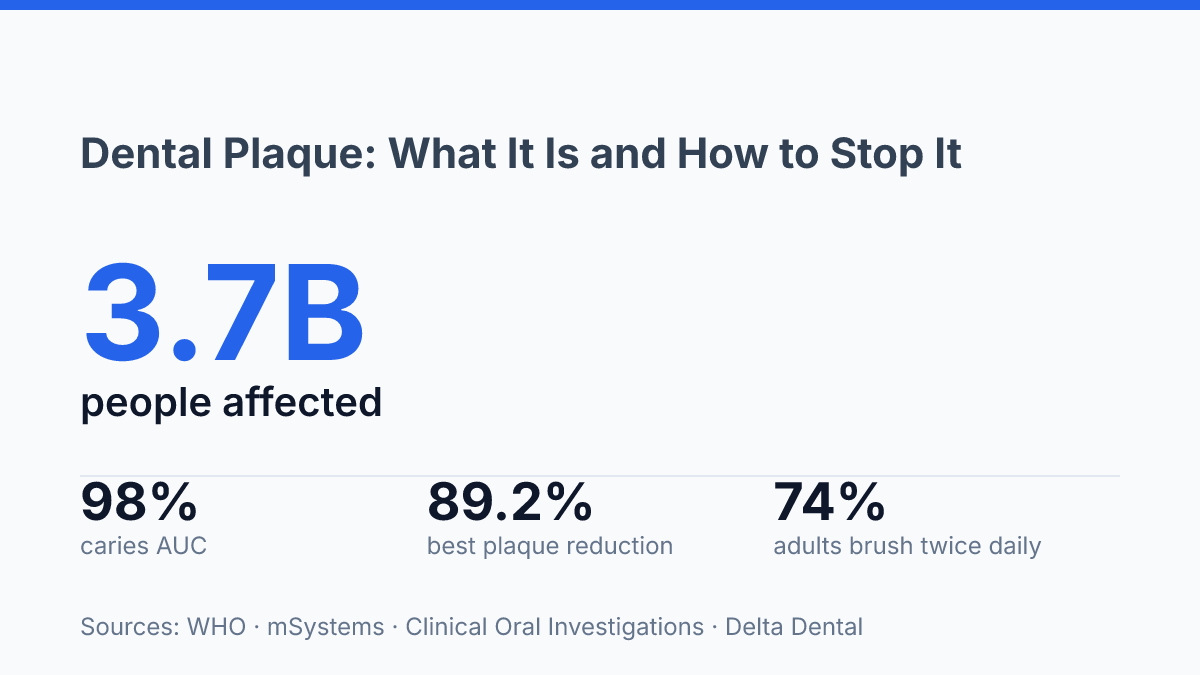
The World Health Organization explains in its oral health fact sheet, updated in 2025, that tooth decay begins when plaque on the tooth surface converts free sugars into acids that destroy tooth structure over time. The scale is hard to dismiss: oral diseases affect nearly 3.7 billion people worldwide, according to the same source.
Plaque is invisible. The harm isn’t.
Its earliest warning signs can look small: a new cavity, gum irritation near the tooth line, or breath that stays sour even after you rinse. These don’t always hurt at first, so people mistake silence for safety.
In my view, the quiet part is what makes plaque so dangerous. You can feel perfectly fine while acids weaken enamel and bacteria irritate gum tissue. By the time the signs become obvious, the biofilm has already changed the conditions on your teeth.
How plaque turns into cavities and gum disease
Your gums can start breaking down before you feel a single toothache. That silence is what makes the problem easy to ignore.
When plaque sits along the tooth surface, its acids pull minerals out of enamel. Dentists call this demineralization.
The plain version is simpler: the hard outer shell gets softer in tiny zones. If that mineral loss continues, the weak spot collapses into a cavity.
The same buildup also irritates the gumline. Gingivitis is the first stage of gum disease.
It doesn’t need to hurt to be real. Bleeding when you brush or floss is often the first warning sign, not the final one.
A 2024 experimental gingivitis study in npj Biofilms and Microbiomes showed how fast this can shift. Researchers had 41 healthy adults stop oral hygiene for two weeks, and measurable plaque-related gum changes appeared by day 14.
That doesn’t mean your mouth falls apart in two weeks. It does show how quickly the balance can move in the wrong direction.
Then tartar changes the rules. Plaque that stays in place can harden into a crusty deposit that locks onto teeth, especially near the gums and between teeth.
Once it hardens, brushing harder won’t solve it. You can irritate your gums and still leave the deposit behind.
That tradeoff matters. The early problem is soft and removable at home. The later problem is mineralized and stubborn. In my honest opinion, bleeding gums deserve more respect than most people give them, because they’re often the cleanest early signal that the chain reaction has already started.
Daily habits that stop buildup before it starts
Two minutes is longer than most people think. It’s the difference between skimming the front teeth and actually reaching the gumline, back molars, and biting surfaces. Brush twice a day for two minutes with fluoride toothpaste.
Don’t rush the evening brush. It carries the most weight because food residue and bacteria shouldn’t sit undisturbed overnight.
A 2024 analysis in BMC Oral Health found that the human mouth contains over 700 prokaryotic species. In 30 samples, researchers detected 383 OTUs across 312 species, with 223 OTUs shared between cheek-lining and tooth-surface samples. That’s why consistency beats force.
You’re not scrubbing off simple dirt. You’re interrupting a living community before it organizes.
Floss once a day to clean between teeth where brushes miss. Timing matters less than completion, so choose the part of the day you’ll actually stick with. If you only floss when something feels stuck, you’re already letting buildup settle in the tight spaces that cause the most trouble.
The hard part isn’t brushing once. It’s doing it long enough and often enough to break the cycle. In my humble opinion, plaque control fails most often from impatience, not ignorance.
A quick 30-second brush feels productive. It leaves too many untouched zones.
Diet matters too, especially frequent snacking on sugary or starchy foods. Three cookies with lunch are not the same as one cookie every hour through the afternoon.
The second pattern keeps restarting the problem. If you snack, pair it with water and give your mouth a break between eating periods.
Keep the routine boring on purpose: brush well, floss daily, and stop feeding the cycle all day. Trendy rinses, abrasive powders, and internet “hacks” won’t make up for missed basics. Simple works, but only when you actually do it.
When home care isn’t enough
A toothbrush can scrub away soft buildup. It can’t chip calcified tartar off enamel without risking damage.
Once that mineralized layer locks onto the tooth, brushing harder only irritates the gums. Floss won’t break it loose either.
That’s the part people get wrong. They treat stubborn buildup as a character flaw.
It can point to a routine that’s missing a surface… or to gum tissue that needs professional help. In my view, guilt is useless here. The useful move is finding the exact place where home care is failing.
Bleeding changes the calculation. If your gums bleed more than once or twice, or plaque seems to return quickly even after careful cleaning, book a routine dental cleaning and exam. The exam matters as much as the cleaning because the dentist or hygienist can check pocket depth, gum inflammation, rough fillings, crowded areas, dry mouth, and other reasons buildup keeps coming back.
Professional cleaning does one thing home care can’t: it removes hardened deposits from above and just below the gumline with dental instruments. That doesn’t make daily brushing optional. It resets the surface so your routine has a fair chance again.
Certain warning signs deserve faster attention: persistent bad breath, swollen gums, tenderness when chewing, tooth sensitivity, gums pulling away from teeth, or a bad taste that doesn’t clear after cleaning your mouth. Pain isn’t the only alarm. Gum disease can stay quiet while damage builds.
Research backs the need for escalation once disease is established. A 2025 Journal of Periodontology study followed 86 people with stage II/III periodontitis for six months and found that professional scaling and root planing, paired with chlorhexidine and interdental cleaning, produced a measurable shift toward a healthier oral microbiome. That’s the tradeoff: home care prevents most trouble, but established gum problems usually need a clinician to change the conditions under the gumline.
The point where brushing stops being enough
The next smart move is not buying every product on the shelf. Track what your mouth is telling you. Bleeding, sour breath, rough spots, and gums that look puffy after a week of better cleaning all deserve a dental exam.
The hard part is knowing when the biofilm has moved from nuisance to disease. A 2025 Journal of Periodontology study followed 86 people with stage II/III periodontitis.
Only one group shifted toward a healthier microbiome. They had scaling and root planing, chlorhexidine, and interdental cleaning.
That’s the line. Dental plaque is manageable at home until it isn’t. In my humble opinion, the win is not perfect teeth. It’s catching the change before your gums pay for the delay.
Frequently Asked Questions
Q: What is dental plaque and why does it build up so fast?
A: Dental plaque is a sticky, invisible film of bacteria that coats your teeth all the time. It builds fast because the bacteria feed on sugars and starches in your food, then keep multiplying. In my view, that’s the part people underestimate most… it starts quietly, then turns into a real problem.
Q: Can dental plaque cause cavities and gum problems?
A: Yes. The acids from plaque attack tooth enamel and can create cavities. They also irritate your gums. You can end up with bleeding or swelling if you ignore it.
Q: How do you get rid of plaque at home?
A: Brush twice a day for two minutes and floss every day. That’s the core routine. It works because it clears the film before it hardens or keeps feeding on food residue. If you skip flossing, you leave a lot behind.
Q: Does mouthwash remove plaque from teeth?
A: Mouthwash can help freshen your breath and reach places your brush misses. It doesn’t replace brushing and flossing. Plaque sticks to teeth, so mechanical cleaning matters most. That’s the difference people miss.
Q: How often should I brush and floss to prevent plaque buildup?
A: Brush twice daily for two minutes each time. Floss once a day, even if your gums bleed a little at first. The routine is simple, but consistency matters more than doing a perfect job once in a while.