
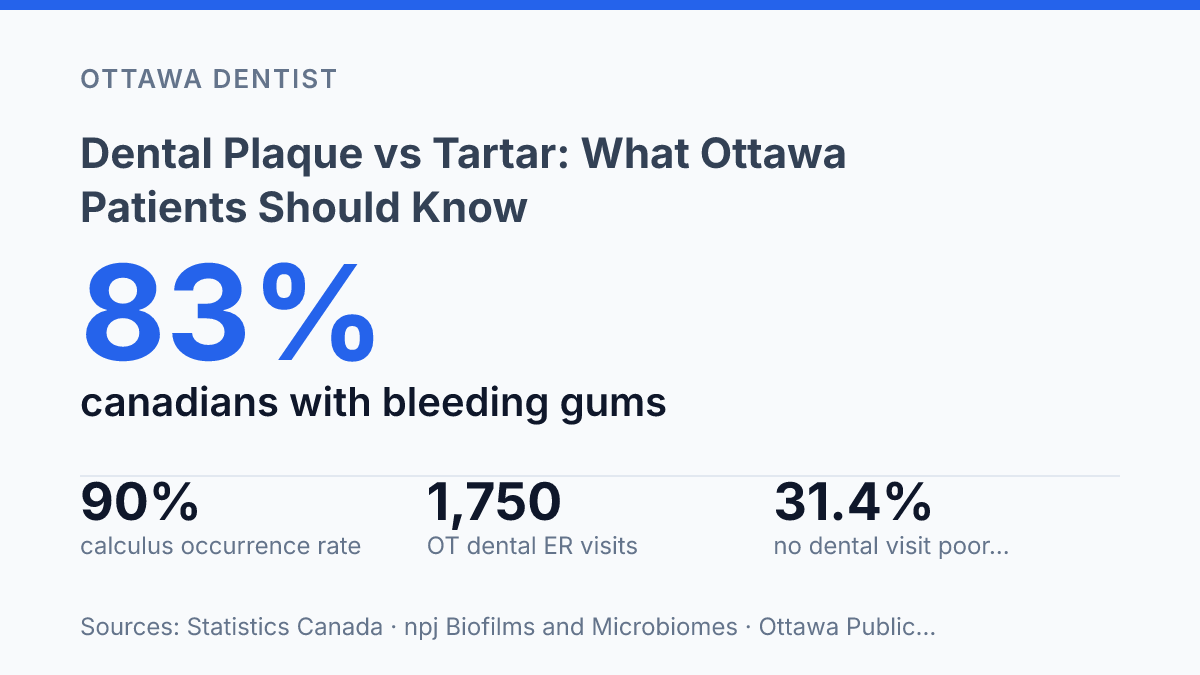
Dental plaque vs tartar isn’t a cosmetic distinction: Statistics Canada found 83% of Canadians aged 20 to 79 had bleeding gums on probing in data through 2024, averaging seven bleeding teeth per person.
That’s not a tiny hygiene miss. It’s a sign that soft buildup and hardened deposits are doing real damage before many people feel pain.
Plaque is the film you can disrupt with a brush, floss. A solid two minutes twice a day.
Tartar is different. It forms when that biofilm hardens with minerals like calcium phosphate, and research estimates dental calculus appears in about 90% of people.
That gap matters in Ottawa, where delayed dental care still sends people to emergency rooms. This comparison draws the line between what you can control at home and what needs a scaler. In my honest opinion, the dangerous part is how easy tartar is to underestimate.
Plaque vs tartar: what changes in the mouth
A soft film on your teeth can start turning into a crust-like deposit before the weekend is over. That speed is the practical heart of dental plaque vs tartar.
Plaque doesn’t wait for a problem to announce itself. It forms constantly as food debris and oral bacteria collect on enamel, around fillings, between teeth, and close to the gums.
Plaque is a soft, sticky biofilm. That word matters. It means bacteria live in an organized layer, not as random specks you can ignore.
The layer feels almost invisible at first. It changes the chemistry sitting against the tooth surface.
The shift happens when plaque stays put. Minerals in saliva begin to soak into that film. The soft layer hardens.
Tartar, also called calculus, can form in about 24 to 72 hours when plaque is left undisturbed. That’s the surprise: the mouth can turn something smearable into something bonded in just a few days.
This isn’t rare or minor. Dental calculus has an estimated 90% occurrence rate in the general population. It forms as plaque bacteria interact with inorganic minerals such as calcium carbonate and calcium phosphate, according to Dang et al., npj Biofilms and Microbiomes. In my view, that statistic should make tartar feel less like a personal failure and more like a predictable biological process.
Once plaque mineralizes, the cleaning strategy changes. The hardened deposit bonds tightly to enamel and along the gumline, especially where saliva minerals collect most easily. Plaque is flexible. Calculus is anchored.
That difference is why the two terms shouldn’t be used as if they mean the same thing. One is a living, sticky layer in motion. The other is that layer after the mouth has turned it into a hard surface.
What you can remove at home, and what you can’t
The spot behind your lower front teeth is one of the mouth’s best tartar traps, even in people who brush carefully.
At home, your tools are simple: a toothbrush and floss. In 2026, Health Canada advises brushing for about 2 minutes at least twice a day and flossing daily to remove plaque before it has the chance to harden. That’s the part you control.
The tempting move is to brush harder once you feel a rough patch. But pressure isn’t precision. Once that deposit has set, aggressive brushing can irritate the gums and wear the tooth surface without actually removing the hardened material.
Professional cleaning works differently. A dental hygienist or dentist uses scaling instruments during your appointment to lift hardened deposits from the tooth surface. That may involve hand scalers, an ultrasonic scaler, or both, depending on where the buildup sits and how firmly it’s attached.
Location explains why some areas keep collecting it. Along the gumline, the toothbrush has to clean a narrow edge where soft tissue, tooth shape, and saliva all meet. On the tongue-side of the lower front teeth, saliva pools near the openings of the salivary glands, so deposits can collect there even when the front surfaces look clean.
That’s the clean line between home care and clinical care. You can remove the soft film every day before it sets. You can’t scrape away hardened buildup safely with a toothbrush, floss pick, fingernail, or drugstore tool. In my honest opinion, the biggest mistake patients make is treating tartar like stubborn plaque, when it’s already crossed into a different removal category.
Why the difference matters for gums and teeth
The first warning sign usually isn’t pain. It’s pink in the sink.
Plaque sitting at the gumline is the main trigger for gingivitis, the early gum inflammation that makes tissue look red, swollen, or quick to bleed. In the 2022–2024 Canadian Health Measures Survey, Statistics Canada reported that 83% of Canadians aged 20 to 79 had bleeding gums on probing, with an average of seven teeth affected.
That national number matters because gingivitis is still the stage where control is realistic. Plaque is the easier problem.
It irritates gum tissue. You can disrupt it before it has time to harden and shield more bacteria.
Tartar changes the texture of the tooth surface. It creates a rough ledge that traps fresh plaque and makes cleaning harder around the edges of teeth.
You can brush with more force and still leave bacteria packed against the hardened deposit. That’s the tradeoff: plaque starts the inflammation, but tartar quietly raises the stakes if you ignore it.
The quiet risk is not that tartar acts alone. It doesn’t.
The problem is the plaque it shelters and the gum inflammation that follows. Bleeding tissue can also make future dental work harder to plan and complete, especially when a dentist needs clean margins, accurate measurements, or stable gum health before treatment.
Routine dental cleanings interrupt that pattern before it becomes a bigger problem. They remove the buildup you can’t clear at home and give your dental team a chance to spot bleeding, swelling, and hard-to-clean areas early. In my humble opinion, the most valuable cleaning is often the one that feels uneventful, because it prevents a small gum issue from turning into a longer, more expensive appointment later.
When to book a cleaning with your Ottawa dentist
A rough patch you can feel with your tongue is often a better booking cue than a mirror check. If a tooth surface feels gritty after brushing, or you see yellow or brown buildup near the gums, that’s the point where home care has probably reached its limit.
You can spot plaque at home, but tartar is where self-care stops being enough. That contrast matters.
Brushing harder won’t solve a hardened deposit. It can irritate the gums if you start scrubbing to compensate.
Bleeding when brushing is another clear signal. A single spot after you rushed with floss may not mean much, but repeated bleeding deserves an exam. Pain is a late warning sign, not the standard you should wait for.
The American Dental Association recommends regular dental visits, with timing based on your risk rather than a fixed rule for everyone. Your dentist may suggest shorter intervals if buildup returns quickly, your gums bleed easily, or you’ve had periodontal concerns before. Someone with stable gums and little accumulation may need a different schedule.
Local context matters too. Ottawa Public Health reported 1,750 emergency department visits for dental conditions best treated elsewhere in 2024.
That number isn’t about routine cleanings alone. It shows what delayed oral care can turn into when small signs get ignored.
If tartar is visible, your teeth feel rough, or your gums bleed when you brush, schedule a professional cleaning and exam with Ottawa Dentist. In my view, the smart move is to treat those signs as booking signals, not personal failures. You’re not trying to diagnose yourself. You’re deciding when the job needs clinical hands.
What Ottawa patients should do before it turns urgent
A cleaning schedule shouldn’t be built on guilt. It should be built on evidence from your own mouth.
Six months works for many people. It isn’t magic. If tartar forms quickly, if your gums bleed, or if pockets are deepening, waiting for the next routine slot can cost you.
Ask your hygienist where deposits collect and how fast they return. That answer is more useful than a generic calendar reminder.
Ottawa Public Health reported 1,750 emergency department visits for dental conditions in 2024 that were better treated elsewhere. That’s the local warning. In my humble opinion, plaque is a daily habit problem, but tartar is a timing problem.
Miss the timing. A simple cleaning can turn into urgent care.
Frequently Asked Questions
Q: How fast does plaque turn into tartar on teeth?
A: It can harden in just 24 to 72 hours. That’s the part people miss… plaque doesn’t wait around. Once it sets into tartar, you can’t brush it off at home.
Q: Can you remove tartar yourself with brushing or flossing?
A: No. Plaque comes off with daily brushing and flossing, but tartar bonds tightly to the tooth surface. You need a dental professional to remove it.
Q: What does plaque look and feel like compared with tartar?
A: Plaque is soft, sticky, and usually hard to notice until it builds up. Tartar is different. It’s a hard, crust-like deposit that clings to teeth. In my view, that hardening is why waiting is a bad tradeoff.
Q: Why does plaque keep coming back after cleaning?
A: Because plaque is a constant film of bacteria that forms on teeth every day. Brushing and flossing remove it. It starts building again soon after. That’s normal. It also means consistency matters.
Q: What’s the difference between plaque and tartar when it comes to dental visits?
A: Plaque is the easier problem. Tartar is the one that needs professional removal once it forms. If you let plaque sit, it can turn into tartar in 24 to 72 hours, so regular cleanings matter.